domingo, 13 de diciembre de 2015

Cuando la naturaleza entra en la ciudad (2) / Sometimes nature enters inside the city


- Urban planning -


Cuando la naturaleza se introduce dentro de la ciudad como sucede en Hong Kong, el resultado es realmente sorprendente. En estos casos la contraposición entre belleza natural y belleza artificial se vuelve muy intensa, se podría decir incluso que ambas llegan a retroalimentarse. Se plantea la eterna duda de cual de las dos debe prevalecer. Tal vez ninguna, porque ambas pueden convivir. Tal y como dijo F.Ll.Wright en "El Futuro de la Arquitectura": si se ha de construir un edificio en la cima de una montaña, debe hacerse a media ladera, de esta forma podrán contemplarse la montaña y el edificio al mismo tiempo, convertidos ambos en una sola cosa.


The result of nature entering inside the city as it happens in Hong Kong, is really surprising. The natural beauty and its opposite artificial beauty, crash abruptly. It seems as both feed back, and it's difficult to say which one has to prevail. Perhaps both should coexist as F.Ll.Wright said in "The Future of Architecture": if a building is built in the summit of a mountain, it has to be placed just in the hillside. Thus, both mountain and building can be contemplated.


   Ciudad de Hong Kong. Fuente: http://www.cntraveller.com


viernes, 11 de diciembre de 2015

Cuando la naturaleza entra en la ciudad (1) / Sometimes nature enters inside the city


- Urban planning -


Cuando la naturaleza se introduce dentro de la ciudad pasando a formar parte de ella como sucede en Bombay (La India), el resultado es realmente sorprendente. En estos casos la contraposición entre belleza natural y belleza artificial se vuelve muy intensa, se podría decir incluso que ambas llegan a retroalimentarse. Se plantea la eterna duda de cual de las dos debe prevalecer. Tal vez ninguna porque ambas pueden convivir. Tal y como dijo F.Ll.Wright en "El Futuro de la Arquitectura": si se ha de construir un edificio en la cima de una montaña, debe hacerse a media ladera, de esta forma podrán contemplarse la montaña y el edificio al mismo tiempo, convertidos ambos en una sola cosa.


The result of nature entering inside the city as it happens in Bombay (La India), is really surprising. The natural beauty and its opposite artificial beauty, crash abruptly. It seems as both feed back, and it's difficult to say which one has to prevail. Perhaps both should coexist as F.Ll.Wright said in "The Future of Architecture": if a building is built in the summit of a mountain, it has to be placed just in the hillside. Thus, both mountain and building can be contemplated.


       Fuente: "Architectural Review". 1086. Año 1987


jueves, 10 de diciembre de 2015

Cuando la naturaleza entra en la arquitectura (3) / Sometimes nature enters inside the architecture


- Architecture&Criticism -


En ocasiones la implantación de un edificio sobre el terreno se hace de tal manera que es la naturaleza la que se introduce dentro de la arquitectura y no al contrario como suele ser más habitual. La belleza del entorno natural pasa a formar parte tanto del exterior como del interior de estos espacios que se caracterizan además por afectar levemente al terreno: la cimentación suele consistir en ligeras perforaciones realizadas en superficie. De esta forma la estructura se eleva ligeramente del terreno creando un lugar justo en el límite entre el espacio interior y el entorno exterior.


Sometimes the implanting of the building into topography, let the nature enters inside the architecture. Then, the beauty of natural environment belongs both to the inside and to the outside of the rooms. The fundations of these buildings are also very light. It's enough with small perforations in the surface of the ground for supporting the house. The structure raises slightly from the land, creating a place just in the limit between the interior space and the exterior environment.


     Sultan Residence,Santa Mónica.Arq.:Raymond kappe.1972. Fuente:GA Houses 1.Editorial A.D.A


miércoles, 9 de diciembre de 2015

¿Qué son las energías renovables? / Which are renewable energies?


- Arquitectura bioclimática -


¿Qué son las energías renovables?

Son la alternativa más limpia para el medio ambiente. Son aquellas que se obtienen de fuentes naturales inagotables, ya sea por la gran cantidad de energía que contienen o porque son capaces de regenerarse por medios naturales o artificiales. Energía eólica, hidroeléctrica, solar, biomasa, mareomotriz…....Sigue en :¿Qué son las energías renovables?.
Fuente: http://www.laregion.es


                Fuente: http://www.economiahoy.mx


viernes, 4 de diciembre de 2015

Imagen urbana


- Urban planning -


¡Qué ciudad!, si pudiera ser construida.
What a city!, if could be built.


jueves, 3 de diciembre de 2015

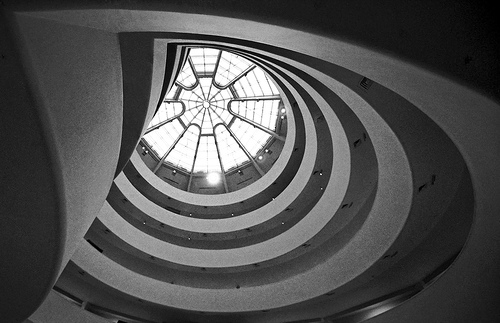
Museo Gughenggeim de Nueva York: la arquitectura y la gravedad


- Architecture&Criticism -


La fuerza de la gravedad está siempre presente en el rostro de la arquitectura a través del peso de los materiales con los que se construye un edificio. Existen casos singulares como el Museo Gughenggeim de Nueva York, diseñado y construido por F.LL.Wright en 1.959. En este caso la gravedad no es algo meramente estático e inerte, sino que es capaz además de dotar de movimiento a todo el proyecto e incluso de generar su funcionamiento. 

Cuando uno entra en el Gughenggeim se topa en primer lugar con el Hall, un magnífico espacio centralizado cubierto con una cúpula de cristal que ilumina todo el museo con luz cenital. Sin duda es este el único vestigio de la arquitectura clásica que puede encontrarse en esta obra de Wright, pero esto no hace sino añadirle valor al conectarla nítidamente con la historia de la arquitectura. A partir de ahí el espectador tiene que coger el ascensor que lo transportará hasta el nivel superior. En ese punto es la propia fuerza de la gravedad la que por inercia le hace descender por la rampa hasta situarlo en cada una de las salas de exposición y finalmente devolverlo  al hall de entrada por el que accedió. La gravedad está presente en todo momento durante este recorrido, pero es la arquitectura la encargada de contenerla para que el espectador descienda suavemente y devolverlo sano y salvo al punto inicial. Justo allí donde la gravedad se convirtió en su guía para visitar el museo.


                                                                               Fuente: www.minube.com


The Gravity Force is always shown in the face of architecture through the weight of materials a building is constructed with. But there are singular buildings as Gughemggeim Museum of New York, designed and constructed by F.Ll.Wright in 1.959, where the gravity is not only something static and motionless, but something as well dinamic and able to generate the movement of visitors inside the building.

When somebody enters inside the Gughemggeim contemplates the Hall, a magnificent centralized space covered with a glass dome that illuminates the whole museum with light from above. Without a doubt, this is the only sign of classical architecture that can be found in the Gughemggeim. Another reason to consider the building as a master piece: the dome conects it directly with architecture history. When the visitor is in the Hall, he has to take the elevator to go up to the upper floor. From this point is the gravity which takes the people and move them by inertia through the spiral ramp until the exhibitions halls and finally to the bottom floor. The gravity force takes visitors throughout the visit, but the architecture stops it for a gentle descent for the people that arrive to the Hall safely, just in the point where gravity started to be their tourist guide.


Fuente: http://www.flickriver.com


lunes, 30 de noviembre de 2015

Campo Baeza gana el Award Grand Prize por un edificio en Zamora


- Actualidad -


El edificio del Consejo Consultivo de la comunidad de Castilla y León en Zamora proyectado por el arquitecto Alberto Campo Baeza se ha hecho con el International Architecture Award Grand Prize, un premio promotido por BigMat.......sigue en: Campo Baeza gana el Award Grand Prize por un edificio en Zamora


Fuente: http://www.leonoticias.com


sábado, 28 de noviembre de 2015

Cuando la naturaleza entra en la arquitectura (2) / Sometimes nature enters inside the architecture


- Architecture&Criticism -


En ocasiones la implantación de un edificio sobre el terreno se hace de tal manera que es la naturaleza la que se introduce dentro de la arquitectura y no al contrario como suele ser más habitual. La belleza del entorno natural pasa a formar parte tanto del exterior como del interior de estos espacios que se caracterizan además por afectar levemente al terreno: la cimentación suele consistir en ligeras perforaciones realizadas en superficie. De esta forma la estructura se eleva ligeramente del terreno creando un lugar justo en el límite entre el espacio interior y el entorno exterior.


Sometimes the implanting of the building into topography, let the nature enters inside the architecture. Then, the beauty of natural environment belongs both to the inside and to the outside of the rooms. The fundations of these buildings are also very light. It's enough with small perforations in the surface of the ground for supporting the house. The structure raises slightly from the land, creating a place just in the limit between the interior space and the exterior environment.


       Casa Levene. Arquitecto.: NO. MAD. Año 2006. Fotografías © Hisao Suzuki.
                

miércoles, 25 de noviembre de 2015

Cuando la naturaleza entra en la arquitectura (1) / Sometimes nature enters inside the architecture


- Architecture&Criticism -


En ocasiones la implantación de un edificio sobre el terreno se hace de tal manera que es la naturaleza la que se introduce dentro de la arquitectura y no al contrario como suele ser más habitual. La belleza del entorno natural pasa a formar parte tanto del exterior como del interior de estos espacios que se caracterizan además por afectar levemente al terreno: la cimentación suele consistir en ligeras perforaciones realizadas en superficie. De esta forma la estructura se eleva ligeramente del terreno creando un lugar justo en el límite entre el espacio interior y el entorno exterior.


Sometimes the implanting of the building into topography, let the nature enters inside the architecture. Then, the beauty of natural environment belongs both to the inside and to the outside of the rooms. The fundations of these buildings are also very light. It's enough with small perforations in the surface of the ground for supporting the house. The structure raises slightly from the land, creating a place just in the limit between the interior space and the exterior environment.


                                   Juvet Landscape Hotel (Noruega). JSA. Architects. 2010


                                           Fuente: http://www.despiertaymira.com


martes, 24 de noviembre de 2015

Alvaro Siza: sitio distinto


- Actualidad -


Siza, sitio distinto

Fuente: http://www.elmundo.es
SizaXSiza' explica la obra del arquitecto portugués a través de seis proyectos y de una larga conversación de 12 horas.

Todo el mundo quiere a los chicos que dibujan bien, a los que cogen el rotulador y tienen la mano fácil para pensar garabateando. Alvaro Siza ya no es un chico, es un señor de 82 años razonablemente bien llevados, pero cualquiera puede buscar sus dibujos y sentir un golpe de simpatía juvenil por él. También aquellos que detestan la arquitectura contemporánea, el esnobismo, la extravagancia y el derroche, sonreirán con los papeles de Siza...........sigue en: Siza, sitio distinto


                                               Autorretrato Siza. Fuente: http://www.elmundo.es

domingo, 22 de noviembre de 2015

Las energías renovables generan ya la mitad de la nueva energía producida en el mundo


- Actualidad -


Las renovables generan ya la mitad de la nueva energía producida en el mundo

Fuente: http://www.elmundo.es
Las energías renovables (principalmente la hidroeléctrica, la eólica y la solar) han contribuido casi a la mitad de la nueva energía generada en 2014 y se han convertido en la segunda fuente mundial de electricidad, después del carbón, según el último informe de la Agencia Internacional de la Energía (AIE).....sigue en: Las renovables generan ya la mitad de la nueva energía producida en el mundo


                   Fuente: http://www.elmundo.es

jueves, 19 de noviembre de 2015

Colegio Mayor Cesar Carlos: la arquitectura y la idea. University Residence Cesar Carlos: the idea in architecture


- Architecture&Criticism -


James Stirling sostenía que un proyecto de arquitectura debe partir de una única idea capaz de extenderse por todos y cada uno de sus rincones. Lo sabía bien Alejandro de la Sota, arquitecto de referencia dentro de la arquitectura española que desarrolló la mayor parte de su obra durante los años 50 y 60 del pasado siglo XX. En el colegio mayor Cesar Carlos el silencio, imprescindible para la concentración de los estudiantes, es la idea que subyace en cada rincón del edificio y que genera todo el proyecto ya desde sus inicios. La propia ordenación volumétrica del colegio así lo atestigua al separarse por completo la recepción y los comedores del volumen principal, mucho más alto, y que contiene las habitaciones y el gimnasio. De esta forma se evitan las molestas carreras por los pasillos que tanto perturban los momentos de estudio. Prácticamente cualquier ruido queda neutralizado dentro del complejo mediante el soterramiento del corredor principal que discurre enterrado entre los dos edificios. Incluso la piscina es cuadrada: dentro de esa forma no se pueden hacer largos interminables que rompan el silencio.


Fuente: http://www.pepecabrera.com


James Stirling said that the architectural project have to be created with one and only idea. Alejandro de la Sota, one of the most important architects of Spain in twenty century, Knew it. That's the reason why the silence is so important in the University Residence Cesar Carlos, designed by De la Sota in 1963. The building is divided in two volumes, one for reception and the university canteens, and other, much more higher, with the rooms and the gymnasium. Therefore, there isn't noise when the students run through the corridors, so annoying to study. In fact, every noise is removed from the building because there is only one buried corridor that connect those two buildings. Even the swimming pool is square: inside this shape is imposible to swimming for a long time breaking the silence.


PLANTS AND SECTIONS:
http://archivo.alejandrodelasota.org


martes, 17 de noviembre de 2015

Arquitecturas Anónimas (4): el espíritu de la arquitectura. Anonymous Architecture: the spirit of architecture


- Architecture&Criticism -


Tal y como defendía Frank Lloyd Wright, el espíritu de la arquitectura no es algo que pueda inocularse desde fuera, reside en su interior y desde allí crece hacia arriba y hacia afuera. En este ejemplo, el castillo de Zorita de los Canes, podría decirse que es el espíritu del terreno el que se extiende desde la roca desnuda hasta los sillares de piedra que forman el edificio. Con él se construyeron sus diferentes estancias: patios, muros, torres defensivas, etc, cumpliéndose a la perfección la ecuación de la arquitectura orgánica:

                                      Suelo = Forma = Función 


As Frank Lloyd Wright said, the espirit of architecture can't be introduced from the outside. It belongs to the architecture, and it grows from the inside out and upward. In the example, the Castle of Zorita (Spain), actually it's the spirit of the the ground that converts the rocks into the stones that forms the spaces of the castle: coutyards, walls and defensive towers. Thus, the equation of organic architecture described in "The Future of Architecture" is perfectly completed:

                                     Ground = Form = Function


CASTILLO DE ZORITA DE LOS CANES. Siglo IX


viernes, 13 de noviembre de 2015

La arquitectura y la velocidad (2) / Architecture and speed


- Architecture&Criticism -


El movimiento Futurista introduce la velocidad como un nuevo componente de la arquitectura moderna. Se crea así un lenguaje formal vinculado al automóvil y a los cambios que estaba introduciendo en la ciudad a principios del siglo XX.  Sin embargo este concepto no era completamente nuevo en la arquitectura, ya estaba implícito en los aparejos de los muros de piedra empleados desde la antigüedad. A través de ellos la fachada adquiría más o menos velocidad en función de las intenciones del arquitecto o de la posición que ocupara dentro del edificio.


The Futurist Movement, introduced the concept of speed into modern architecture at the beginning of XX century. Therefore a new formal lenguage is created in relationship with the car as a new object that had transformed completely the fisonomy of the city. However, this concept wasn't entirely new in architecture, it was already implicit in the stone walls used since antiquity. With them, the facade of a building got more or less speed depending on the intention of the architect or its location inside the building. Other meanings that can be found in a stone wall, are: scale, expressiveness, límit, etc.


                                                          http://lunaticageologia.blogspot.com.es
                                     Speed: low                              Velocidad: baja
                                     Expressiveness: intense            Expresividad: intensa
                                                  Scale: public                                    Escala: pública
                                                  Limit: defined                                   Limite: definido


                                                                                 http://www.estecha.com
                                     Speed: hight                              Velocidad: alta
                                     Expressiveness: neutral              Expresividad: neutra
                                                 Scale: private                              Escala: privada
                                                 Limit: defined                              Limite: definido


                                                                             http://www.estecha.com
                                     Speed: hight                                Velocidad: alta
                                     Expressiveness: intense              Expresividad: intensa
                                                 Scale: private                               Escala: privada
                                                 Limit: defined                               Limite: definido


                                                                   http://www.estecha.com

                                       Speed: low                                Velocidad: baja
                                       Expressiveness: intense            Expresividad: intensa
                                                    Scale: public                     Escala: pública
                                                    Limit: diffuse                     Limite: difuso


                                                    Fuente. http://picphotos.net

                                     Speed: low                                Velocidad: baja
                                     Expressiveness: intense            Expresividad: intensa
                                                 Scale: public                              Escala: pública
                                                 Limit: diffuse                     Limite: difuso


                                                             Fuente:www.piedranatural.es
                                     Speed: low                                Velocidad: baja
                                     Expressiveness: intense            Expresividad: intensa
                                                 Scale: public                              Escala: pública
                                                 Limit: defined                     Limite: definido